title: "Beyond RPA: How We Build Autonomous AI Agents to Resolve Complex Support Tickets" category: "Generative AI" date: "2026-04-03T11:00:00Z" author: "Elena Rodriguez" readTime: 7 excerpt: "Traditional RPA bots break when workflows change. We explore how modern LLMs and agentic workflows are solving complex tier-2 B2B support tickets autonomously."
For the past decade, Robotic Process Automation (RPA) has been the silver bullet for enterprise efficiency. Companies saved millions by mapping out click-paths and using screen-scraping bots to move data from System A to System B.
But traditional RPA has a fatal flaw: it is incredibly brittle. If an invoice format changes, or a customer phrases a request differently, the bot crashes and falls back to a human agent.
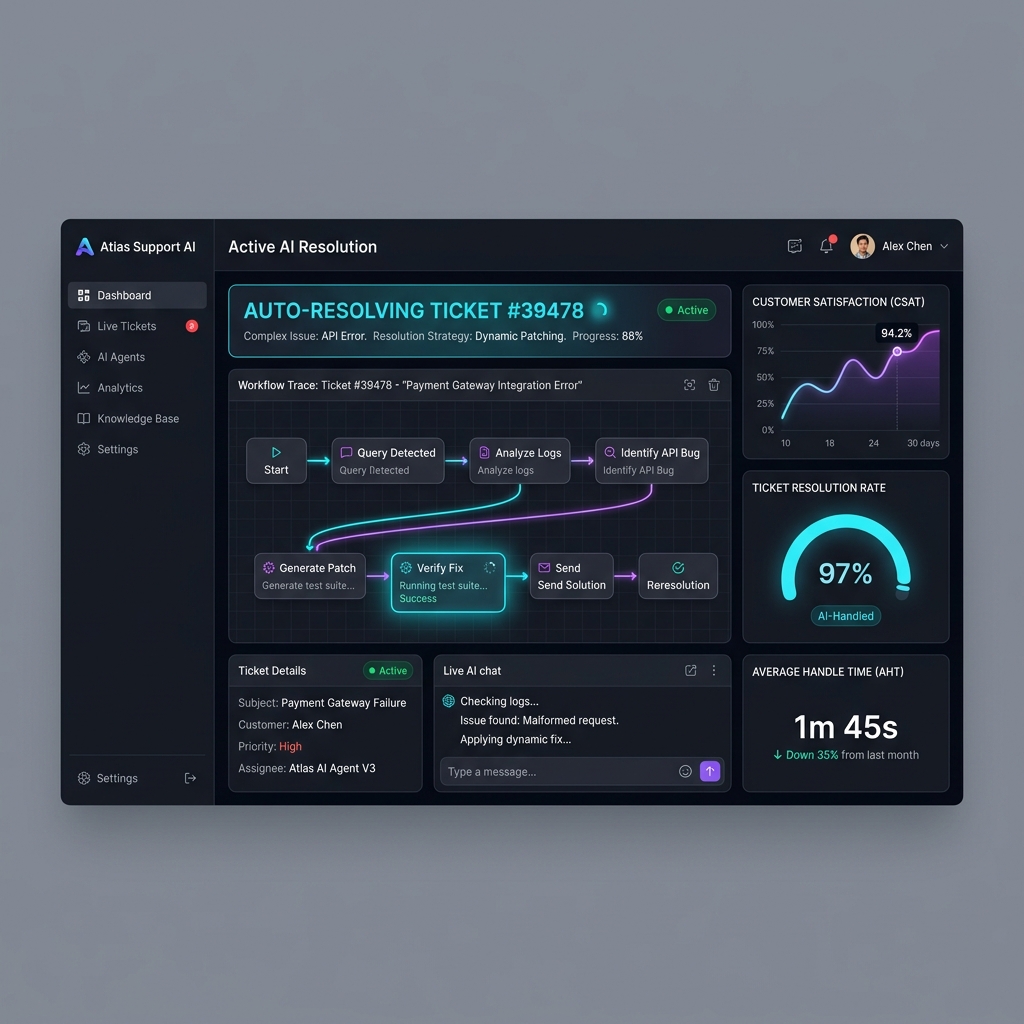
At Dymaxel, we are replacing fragile RPA with Autonomous AI Agents powered by large language models (LLMs) and intelligent workflow orchestration (using LangChain and dynamic tool usage).
The Limits of Rule-Based Support
Consider a B2B SaaS company managing 5,000+ support tickets daily. In a classic RPA setup, you might use a rule: If the email contains 'refund', trigger the Refund Macro.
But what if the customer writes: "I accidentally subscribed to the yearly plan instead of monthly, can we adjust the billing difference?"
Rules-based bots fail here. They lack semantic understanding.
Enter Agentic Workflows
An Autonomous AI Agent operates entirely differently from a traditional script. It is given a persona, an objective, and a set of API tools.
Here’s how our Dymaxel engineers structure a Support Agent using GPT-4o:
1. Semantic Triage & RAG: When the ticket arrives, the agent reads the context. It queries a vector database (Retrieval-Augmented Generation) loaded with your company’s internal product guides and historical ticket resolutions to find the exact protocol required.
2. Reasoning and Tool Usage: The agent forms an Action Plan. For the billing issue above, it might reason: Step 1: Check Stripe for the recent payment. Step 2: Verify the company's downgrade policy. Step 3: Issue a partial prorated refund via Stripe API.
3. Execution and Human-in-the-Loop (HITL): The agent executes API calls. For sensitive actions (like moving money), the system pauses and pings an escalating Slack channel for a human manager to click "Approve".
The Measurable Impact
By deploying Agentic Workflows, we have seen enterprise clients achieve up to 72% resolution rates without human intervention on Tier-1 and Tier-2 tickets.
More importantly, because the agents interact directly with REST APIs instead of simulating mouse clicks, they execute in milliseconds and never break when a UI updates.
Prepare for the Autonomous Enterprise
We are rapidly moving from software that simply records work, to software that does the work. By merging deep ERP integrations with autonomous agents, your business can scale infinitely without linearly scaling headcount.
Ready to implement autonomous workflows? Dymaxel builds secure, localized AI agents tailored to your secure data. Watch a demo and start a conversation today.