title: "Refactoring the Monolith: When to Transition from Legacy ERP to Custom Microservices" category: "Custom Software" date: "2026-04-03T12:00:00Z" author: "David Chen" readTime: 5 excerpt: "Is your legacy ERP holding back your growth? Discover the technical tipping points that signal it's time to transition to a modern, scalable microservices architecture."
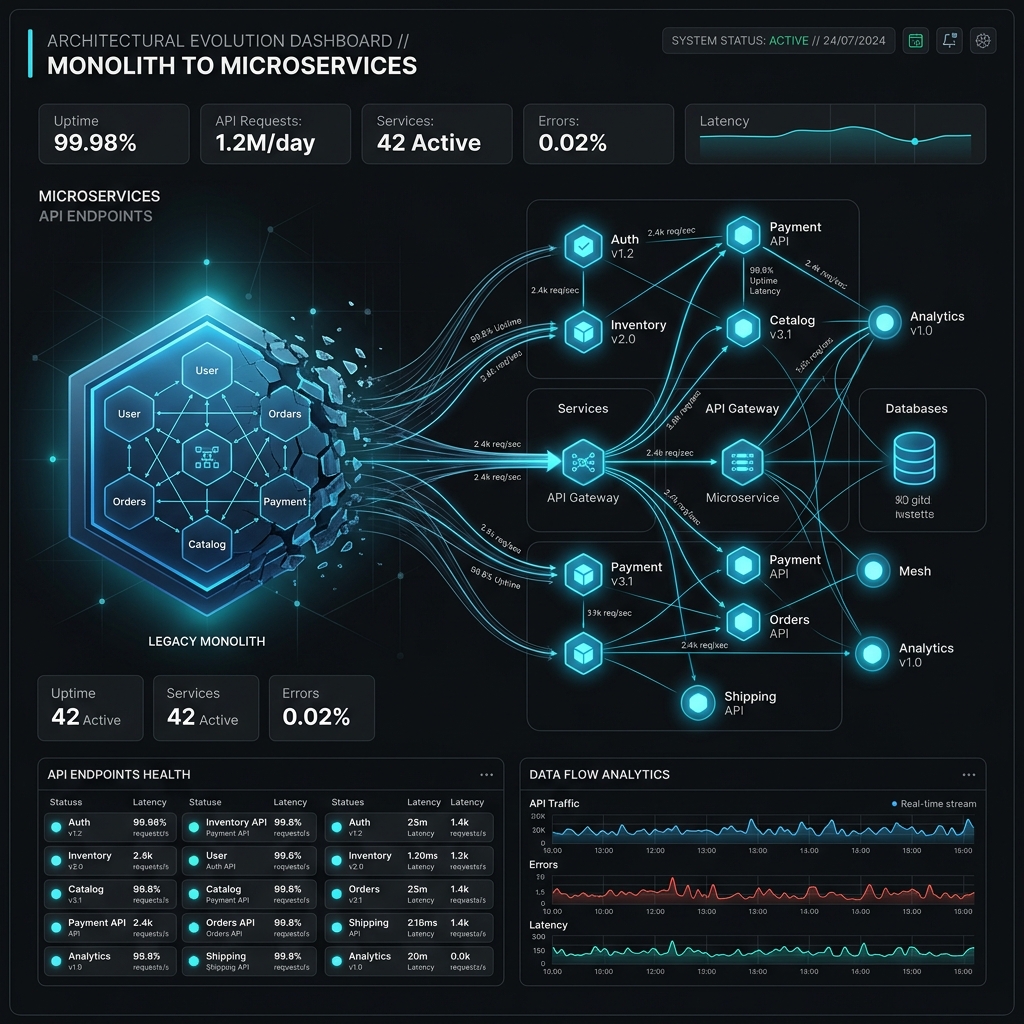
Mid-market enterprises often reach a painful phase in their growth lifecycle: the realization that the software stack that got them to $50M in revenue is actively preventing them from reaching $150M.
Usually, the culprit is a legacy ERP. Monolithic systems deployed a decade ago become tangled webs of unmaintainable code, custom-patched databases, and brittle integrations that break every time the vendor forces an update.
At Dymaxel, we help CTOs and operations leaders navigate the complex pivot from monolithic legacy software to modern, agile microservices architectures—frequently utilizing modular Odoo 18, PostgreSQL, and scalable Node.js deployments.
Recognizing the Tipping Point
How do you know it's time to refactor the monolith? Look for these 3 critical failure patterns:
1. The "Feature Freeze" Phenomenon Your sales team requests a new B2B portal pricing logic. Your engineering team estimates it will take 4 months because altering the pricing table requires rewriting code tied to inventory and accounting. If development velocity has slowed to a crawl due to tightly coupled dependencies, your architecture is failing you.
2. The Integration Nightmare Modern businesses run on best-of-breed tools. If connecting HubSpot, a 3PL logistics provider, or a new payment gateway like Stripe requires building massive, hacky middleware scripts because your ERP lacks a clean REST or GraphQL API, you are accumulating massive technical debt.
3. Single Point of Failure Scaling If a spike in e-commerce traffic on Black Friday slows down your warehouse scanners because they share the exact same monolithic database and server resources, you have a critical scalability flaw.
The Strategic Transition to Microservices
The solution isn’t to "rip and replace" everything on a Friday night. That is incredibly risky. The engineering paradigm that Dymaxel advocates is the Strangler Fig Pattern.
Instead of rewriting the ERP all at once, we decouple your operations module by module:
- The API Layer: We introduce an API Gateway to sit in front of your legacy system.
- Modular Extraction: We rebuild one specific flow (e.g., Inventory Management) as an independent scalable microservice (often using Odoo's modular components or a custom Node.js backend).
- Traffic Routing: The API Gateway routes all inventory requests to the new microservice, while standard accounting still hits the legacy monolith.
- Phased Retirement: Over 12–18 months, module by module, the legacy monolith shrinks until it is safely retired.
Business Value Realized
Refactoring your software architecture is an investment that pays immense dividends. Your engineering velocity skyrockets, localized server failures no longer take down the entire company, and your business can rapidly adapt to new market opportunities via headless integrations.
Stop letting software dictate your growth. Connect with Dymaxel to schedule an Architecture Audit and Modernization Strategy for your enterprise.